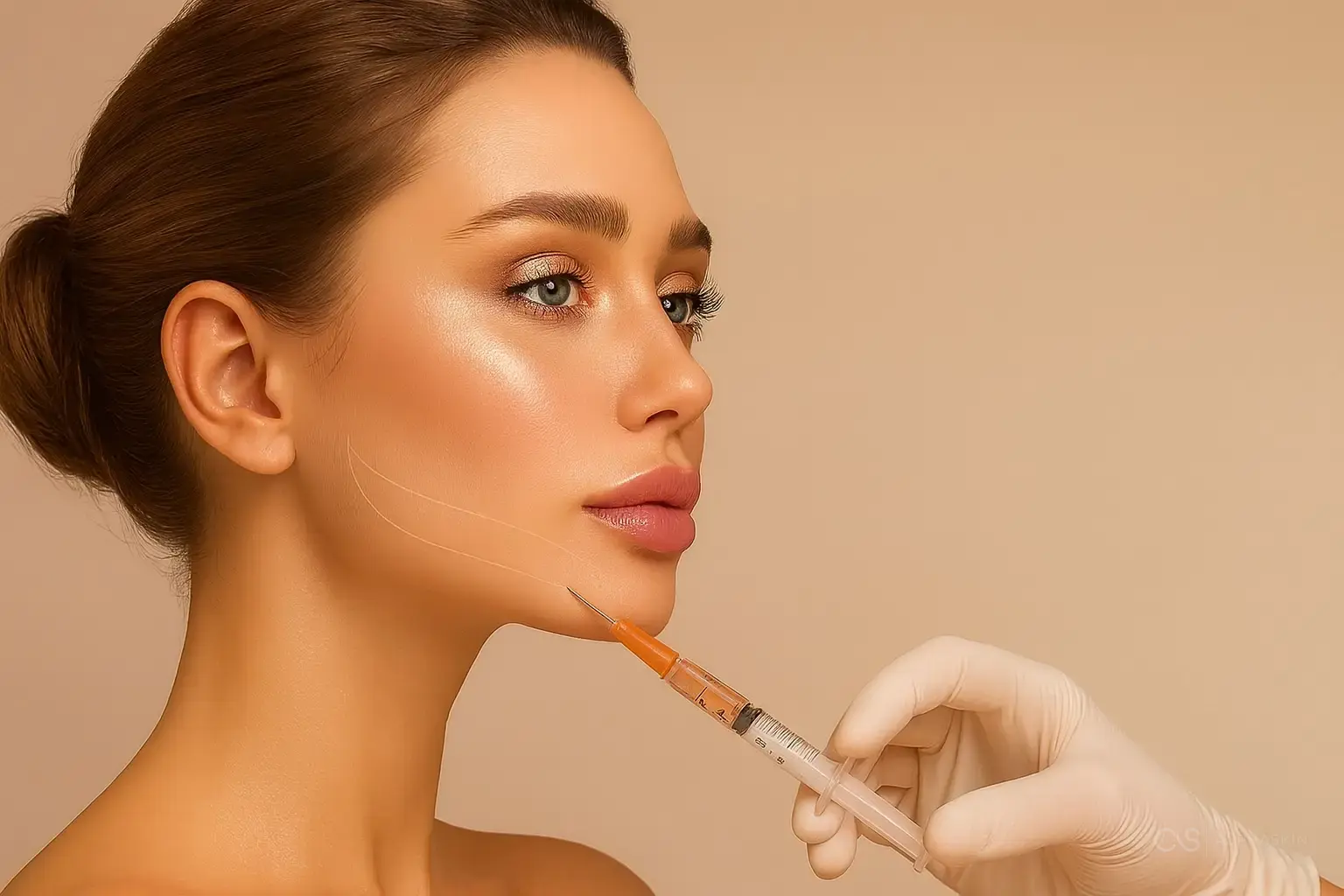
Hyaluronic acid and Botox® are often mentioned in the same breath. Both are injected, both act against wrinkles – and yet they work completely differently. Botulinum toxin, the active substance behind Botox®, relaxes muscles. Hyaluronic acid fills what is missing in volume.
Which treatment suits therefore depends above all on how a wrinkle arises. This article compares both methods and shows when which makes sense – and when both together.
The comparison at a glance
| Botulinum toxin (e.g. Botox®) | Hyaluronic acid filler | |
|---|---|---|
| What it is | prescription-only medicine | gel made of hyaluronic acid, a substance produced by the body (medical device) |
| How it works | relaxes individual muscles in a targeted way | fills volume and supports the tissue |
| Typical areas | frown line, forehead, crow's feet; armpits in cases of heavy sweating | nasolabial folds, lips, cheeks, chin, tear trough |
| Effect visible | after 2–5 days, full after about 2 weeks | immediately, final after swelling subsides (1–2 weeks) |
| Usually lasts | 3–4 months | 6–12 months, longer depending on product and area |
| Common side effects | redness, small bruises, headaches | swelling, bruises, feeling of pressure |
| Rare side effects | temporarily drooping eyelid or uneven facial expression | nodules, inflammation; very rarely vascular occlusion |
| Reversing | not possible, wears off by itself after months | can be dissolved with the enzyme hyaluronidase (Hylase) |
When which treatment suits
Wrinkles from movement: botulinum toxin
Some wrinkles arise because a muscle contracts a thousand times: when frowning, raising the eyebrows or smiling. Such expression lines are at first visible only in movement and etch in over the years. Botulinum toxin inhibits signal transmission from the nerve to the muscle, the muscle relaxes, the skin above it becomes smoother.
This concerns above all the upper face: frown line, horizontal forehead lines and crow's feet. More on this in the article 10 things you should know about Botox®.
Missing volume and deep wrinkles at rest: hyaluronic acid
Over the years the face loses volume and firmness. Cheeks flatten, the folds between nose and corners of the mouth become deeper, the lips thinner. These changes have little to do with muscle movement – here relaxing does not help, here substance is missing.
Hyaluronic acid binds water and occurs naturally in connective tissue. Injected under the skin as a gel, it balances volume, supports the tissue and smooths deep wrinkles. You will find typical areas of use under Fillers and facial contouring, Lip augmentation and Tear trough.
Often sensible: both combined
Many faces show both: expression lines on the forehead and loss of volume in the mid-face. Then both methods are often combined, each where it works. Whether in the same appointment or one after the other, the physician decides in each individual case.
Not everyone should be treated
During pregnancy and breastfeeding, neither method is used. Also in cases of inflammation or cold sores in the treatment area, treatment is postponed. With botulinum toxin, certain diseases of the nerves and muscles, such as myasthenia gravis, are also a reason for exclusion. Blood-thinning medication increases the risk of bruising with both methods. That is why the physician asks precisely about pre-existing conditions and medication in the consultation.
If the result does not suit
Botulinum toxin cannot be reversed, but the effect wears off by itself after a few months. Hyaluronic acid can be dissolved with the enzyme hyaluronidase if needed, for example in the case of nodules or an uneven result. How that works is explained in the article Hylase: dissolving fillers.
The decision is made in conversation
Whether botulinum toxin, hyaluronic acid or both: what is decisive is how your wrinkles arise and what you wish for. In the consultation the physician looks at your face calmly and in movement and explains what is realistically achievable.
The cost follows the German medical fee schedule (GOÄ), the amount of the product and the number of treated areas. The current prices are on the treatment pages.
Read on:
The Alpha Skin practice is located at Theaterplatz 1b in Bonn-Bad Godesberg.